A grid is cut from the whiteness of the page. The lines are drawn, the clues deployed. Shot through with blank spaces, the words to fill them skulk somewhere offstage, idly standing by. I look for them, but they are recalcitrant, reluctant, lazy. I love them anyway.
The thing about words is that they always have to be found. And we can’t move on until we’ve found them.
Like the cool white piano keys waiting for fingers, or a sweet mocking mouth concealing a kiss, the puzzle’s purpose seems pre-destined, inescapable. To see a piano is to want to finger a single key, to feel the sound. The mocking mouth dares everyone to uncover its kiss and no dare, especially such a sweet one, goes long without being accepted. And like them, the crossword will find its words. Unfinished always seems almost finished, an in-between, a lure, always just on the verge. Unfinished, like mystery and desire, paces on until gratified.
For our crossword, crafted with such care, we want each word to fit naturally and perfectly with its partners in precise synchronicity, a Busby Berkeley dance of language, each word jumping into the whiteness, folding its lithesome legs together on cue, tantalizing, kaleidoscopic.
These words look for form through clues, midwifed by each of us with enough curiosity and time to sit down, to fill the page, exhaust the ink. The puzzle longs to be filled and fulfilled, spattered with answers, its last space emptied of emptiness and patiently completed, the mystery gratified.
The clues elude us. They emerge randomly, drifting in without a sign and vanishing before anyone can grasp their possibilities. In their sudden appearances and disappearances, they beg for words to fill the emptiness they leave behind. And here the clues are so cryptic as to be almost invisible, so subtle one wonders if they are only tricks of perception, mere red herrings. Some clues are metaphors so complete that reality seems a cheap stand-in, even if they are embedded in reality. The breeze that lifts the gauzy white curtain just so. A sandbox, moist with fall rain. The soft sobbing of a lover mingling with the clatter of a waterfall. These are the clues, easily missed.
Each of these painfully human and imperfectly magical occurrences requires words to interlock together, to make sense and give form. Each word, each sensation wants another word to nestle against, with each part of itself giving strength and meaning to its partner. We wish for every word to become that much more, every part of our words to bear weight, to work. There are always black spaces however, gaps in the grid, hard ruptures, ineffable voids where no words or letters seem to fit.
We have no words except those spoken by others. Though we may sometimes invent new ones or bend the familiar to suit new purposes, old and simple words are perhaps best. Out of the most ordinary units of language, we can craft phrases so mellifluous that mouths long to repeat them. The right words are everywhere, they need only to be called out and put to form. Hidden in the most mundane of magazines and newspapers, words are waiting to be found and placed. Bright poems can be marked from their dull sheets. We have only to find the words, to labor with each clue, to unlock all the secrets whispered to us in arcane codes, minuets of sound and light, secret alphabets, unshattering ciphers.
Words and puzzles can be shaped in any way we want them, not just paragraphs and grids but rain streaming, ships sailing, flowers blooming. Picture them. With infinity, probability, time. What we can do with words.
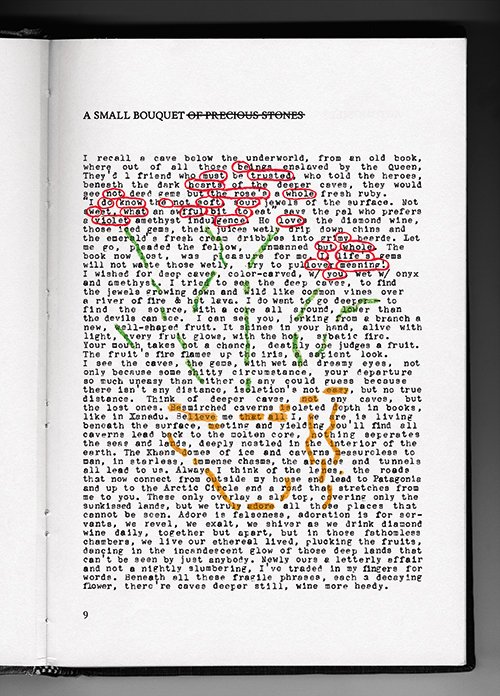
Natalie Czech invited me to take a poem by Frank O’Hara, a calligram (a beautiful, snaking song of a word, a kind of poem that literally takes a shape) and write on top of it, to mount each of Frank’s letters with my own, to erase all the white space with my words. But the overlay had to be precise, a word game, a crossword. Frank shaped his words into a bouquet of flowers, delivered with affection, a love poem. Mine was too in its way, a tender letter of pleasure domes and diamond wines and the fresh cream of emeralds dripping into grimy beards, all penned to someone who’d just been carried away by an airplane and circumstance. I wrote that all the caves beneath the earth connected to its molten core and back to each of us. I wrote that words would have to replace fingers, even though we both knew that words are no replacement for fingers.
I concluded then, “Beneath all these fragile phrases, each a decaying flower, there’re caves deeper still, wines more heady.” Words can sometimes know what fingers and writers cannot. I dreamed of continued pleasure, but intimated, unknowingly, that those deeper caves and headier wines were to be with other lovers.
Did Frank’s bouquet fork lightning, engender a kiss, a devotion, a few minutes of tenderness?
My words, even these, are written like letters, always from me to you. I like thinking of the reader, you, reading it all by yourself. It creates a kind of intimacy: as I write this in bed, you can read it there by the light of a shaded lamp, dripping off into sleep with the susurrus of each uttered word. You can, if you want, step into the stream of words from one lover to another, let it wash over you, go waist deep in longing, without necessarily having to get wet.
I’ve never actually met Natalie Czech or Frank O’Hara, but the project has given us the intimacy of friends. I do not wish to call my collaborators, witting and unwitting, Czech or O’Hara, but Natalie and Frank. (As you’re reading, just put this all in a whisper and it won’t seem so gauche.) Natalie’s photograph of my words on top of Frank’s words feels like more than just a simple snapshot of blooming love. It captures, across time and space, two couples: me with my lover and Frank with his. However unlikely it is that we find ourselves all together, here we are. Words on top of words feel so natural, lovers on top of lovers, an intersection, a crossing, a possibly profound connection, if you’ll allow a tease of sentiment to feather across the page.
The composition was like writing a sonnet, but rather than a forced rhythm and rhyme, I had Frank’s shapely colors and syllables to constrain, branching their way through the tableau of the text.
Frank’s love gives shape to the expression of mine. After I wrote my piece, carefully aligning it with Frank’s words, I sent it to Natalie, who turned it into a photograph. Her photo was really a photo, catching the light of an ephemeral moment. By turning it into a photo, she recorded a time that has since passed.
And her photo of my words is so much more than a snapshot of a love affair would be: two partners arm in arm, smiling in the sun with a simple joy that hides the nuance of their relations. With words we can read the strange comfort and intense histories of two bodies that have slept in attic beds and sweated fevers and wept for hours without speaking, together. A shared space and time, brief enough to burn with the savage energy of a rocket screaming across the sky. All you have here are words of course, but perhaps they can reveal interior lives like glimpses of a thigh through a torn dress. Even though Czech reveals only words, they can show what pictures can’t: the hidden circuits, nerves and passions, the foresight of failure, the rhythm of a profound love slipping away, each word pendulous with quiet fights in foreign countries, bonds forged in adultery, and long days in bed, where the interstice between sleeping and fucking dissolves with sweat. This might be difficult to capture in a single picture, but not in a single paragraph.
Natalie snapshots this moment. It contains both all the history and intimacy of words, and the all-at-once of a picture. The words fade in and out as they shift from language to image. Frank made words from pictures, Natalie makes pictures from words. I’m the middleman.
The writing is first Frank’s and then mine, and then Natalie’s, documentation of an experiment she initiated. Orchestrate as she might, Natalie couldn’t control at all the results of her experiment. No matchmaker can, really. The invitation was an open one, not unlike this one. And with this opening, I wrote my love letter atop Frank’s. Natalie couldn’t have known when she invited me the longing that permeated my writing during those days or the search for lost memories or fictions of the others who overlaid Frank’s calligram. It was open, and the words shaped themselves, only restricted by the design of the overlay.
Perhaps if I had just marched in a protest or fought in a war or completed my PhD or rode a horse, the words might have been laden with different ideas, even a refusal of emotions, an attempt to hide an interior, depersonalize the language, make them as sticky as fluorescent light in a waiting room, as friendly as a latex glove. But instead they are pining, with all that opening up and reaching out, consciously and unconsciously marking the emotional depth and turmoil of that moment.
I am grateful for Natalie’s photograph because, like many photographs, it gives me a safe separation from that dangerous time. I can’t read any of the other letters anymore, but I can look at this bouquet, a picture of those words. Its layers give me distance, and with that distance a kind of succor.
But while her photograph can give me space away from that period, a puzzle that allows me to step away, then it can also collapse a false distance, let me into places that would otherwise be closed off. In another body of work, Natalie took a number of randomish texts, mostly of the polite, responsible variety, mostly from news and art magazines, as well as an unkind editorial letter to the artist and critic Donald Judd (about the alleged formlessness of his writing). Like a diligent idler, a searcher, a liberated reader, Natalie selected words and word fragments from the pages that matched short works by significant writers: Jack Kerouac, E. E. Cummings, Velimir Khlebnikov. This almost seems like a waiting room game, a crossword of almost impossible prolixity. As a person who cares for visual art, for me the Judd letter has a certain inside jokiness, but the other texts are more flat. You might glance at them at the dentist’s office, without reading them, just so you don’t have to stare at the other patients or the beige walls with sad posters of paintings by artists only famous in dentist’s offices. (Another kind of writing-as-picture, perhaps.) Natalie found poetry in these mundane publications, and here has documented her findings.
Her photos mark the end of the game, the right words circled or the wrong ones crossed out. In looking at the found poems, I am reminded that all mundane texts contain so much poetry. All we ever need is here. The words require only to be saved from the drudgery of bad writing, freed from the sad articles written only to stave off the fear of a drill, to pass the time, to advance a career, to avoid where one is. Her photographs invite me to find mysteries and codes in every newspaper rattling with natural disasters and international intrigue, to see in every magazine filled with descriptions and jargon a place where great poems can hide. We have only to puzzle them out, to bring them together, make them endure.
The thing about words is that they always have to be found. And we can’t move on until we’ve found them.
The clues beckon.