The palace gardens are empty and you are chasing after the wind. Everything is impossibly perfect, every stone in every wall, every broken Doric column, every staircase, every tree and every leaf. The perfection and geometries unnerve in their emptiness. Nobody is there. They’ve just left, as if you’ve only missed them by moments. You imagine an aging dowager’s garden party just disappeared as you turned the corner, the musicians brought from the furthest reaches of the empire played harmonic crystals with wet fingers and plucked taut strings that resonated like the cry of kittens on the wind. You feel the dissipated pomp of a fading aristocrat’s masked ball, each costume wrought with bone porcelain inlaid with precious metals and jewels and profuse with the feathers of extinct birds. Both are gone, leaving behind only your dreams of them. You wander through courtyard after courtyard, and the delicacy of the leaves on all the trees exhibits exquisite craftsmanship, preternatural in their refinement. You wonder if you’ve been locked into a guilty industrialist’s labyrinth so that none of his ghosts that chase him would ever find their way through to vengeance. Or maybe you are in the gardens of a pristine seaside manse left behind by the fleeing ancien regime, the revolution already turning them into spectres. Or perhaps a necropolis built by a god-king or dictator whose name is long forgotten, a vast and desolate monument to the perfect harmony of lost power. The emptiness and calm long for meaning, for action, for explanation, but there is none.
You wander not knowing how you got there or who you are or where to go. You are trapped in this puzzle, to find your way you have to find yourself. Orpheus searching for a Eurydice he can no longer remember, all he has left is the longing for which there is no cure, even so he still has a song that can summon beauty but without answers. It’s Last Year at Marienbad, but the hotel is empty but still you peek around corners, wander through the hedges and forests looking for your lover. But it’s just you. Each tableau you long to fill, but they remain blank, mysterious. As crisp as early morning light after a rain but where only the clarity seems real. You are the sole audience to a vast play, the theatre encompassing reality itself, and you wait, full of tantalizing expectation for the drama to start. For the players to plot and argue, to toss back and forth witticisms and accusations, for the parties and trials and courtships and sword fights and songs. You can feel the murder about to happen, for the lovers to fall in love, for the serenity to be destroyed by a dropped bomb or an angry mob. Both real and unreal, familiar and uncanny, a vast, vacant maze filled with the shadows of memories that you can never quite recall.
Or this is how the work of Mare Vint makes me feel.
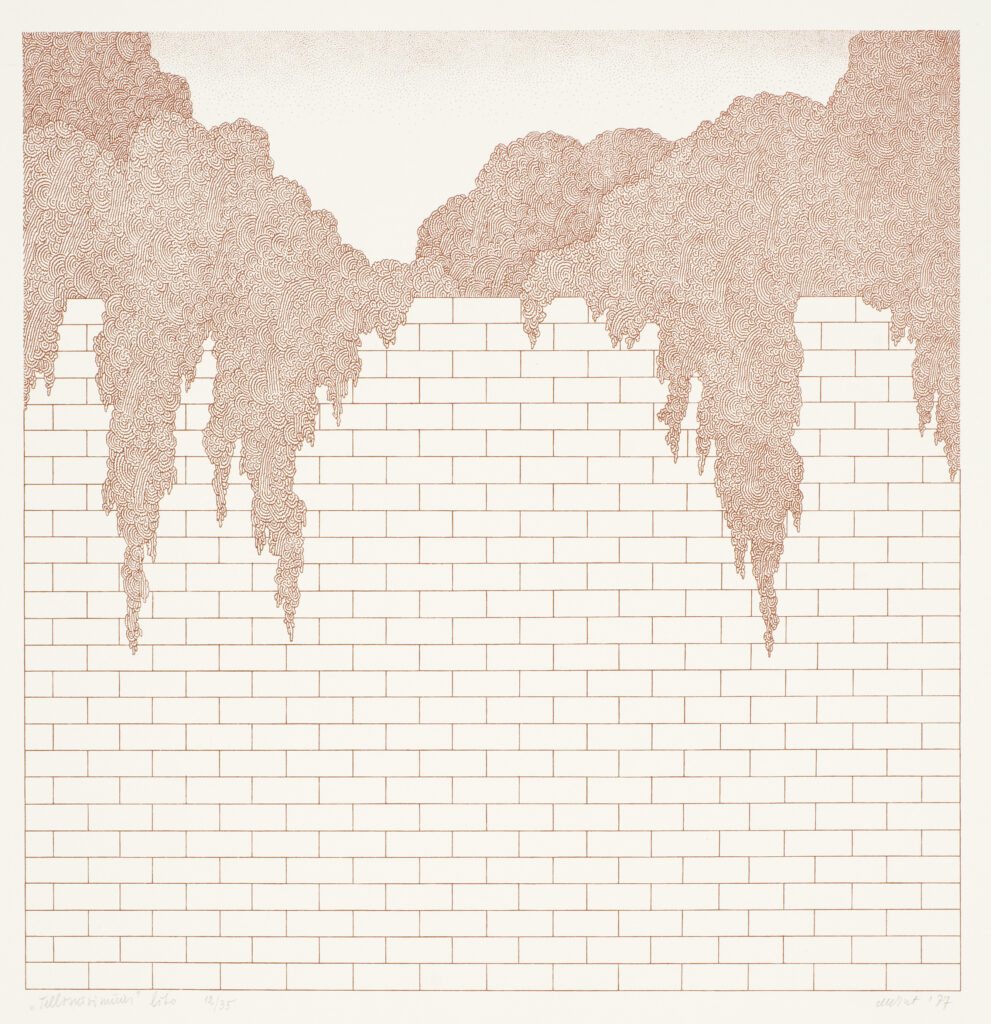
Haunted and haunting, the spare, clean landscapes of Estonian artist Mare Vint’s (b. Tallinn, 1942) drawings and prints create blank planes of perfect, unblemished walls and walkways, monuments and buildings (the occasional vast and vacant ocean) balanced in their chill clarity against the crowded perfection of lush plants and skeletal trees, the leaves rendered in lines that crowd with the obsessive precision of Seurat and when naked, their dark abundance vein and artery with almost anatomical accuracy. Wrought over a fifty-year career, her control over these lines, their hard stare and mad profusions, was largely in pursuit of a certain harmony, an “ideal landscape” that balances, like an aristocratic garden, the man-made against the natural (even if the man-made readily employs natural materials and nature’s warped and bent to human will as to be a cipher for our desire for abstract ideals). And though often displaying almost timeless spaces, when her drawings crisscross with the diamonds of a chain-link fence, the hard harmony hints at the most modern designs of control. When people appear, and they rarely ever did except in the beginning of these spooky realms, they are women, mournfully dressed with their backs turned to us, a funereal tone, almost like Edward Gorey but without any of his macabre, Edwardian snickering.
Black ink and expanses of white paper and canvas dominate her oeuvre, but a couple decades deep color seeps in through open doors, the foliage like green and red mist just on the other side of the wall. The cities and larger natural landscapes that came in the 90s from afar look ethereal and upon closer examination reveal incredible handwork, cross-hatching that makes the pyramids and obelisks of this period like mirages dissipating into faded hues of sunset phantoms. At moments the geometry seems to leak out of the buildings and gardens, hinting at some hidden order, a blueprint for a more subtle universe, but even so they never give away their secrets. And though austere, Mare’s work holds an extraordinary charm. There’s the cool compositional clarity of Japanese landscape, particularly ukiyo-e, the flat, formal spaces of a “floating world”. She has the charm of feminine/feminist faux-naivete, the whorls of foliage like the most diligently obsessive doodles on a teenager’s Trapper-Keeper. And a restrained poetic Symbolism, these artificial landscapes shrouded in the ideal and hiding mystical desire. And even if certain ancient architectural details poke out here and there, they hardly represent any place real of any particular time, but something wholly imagined, a place beyond. Beyond where exactly? Soviet Estonia perhaps.
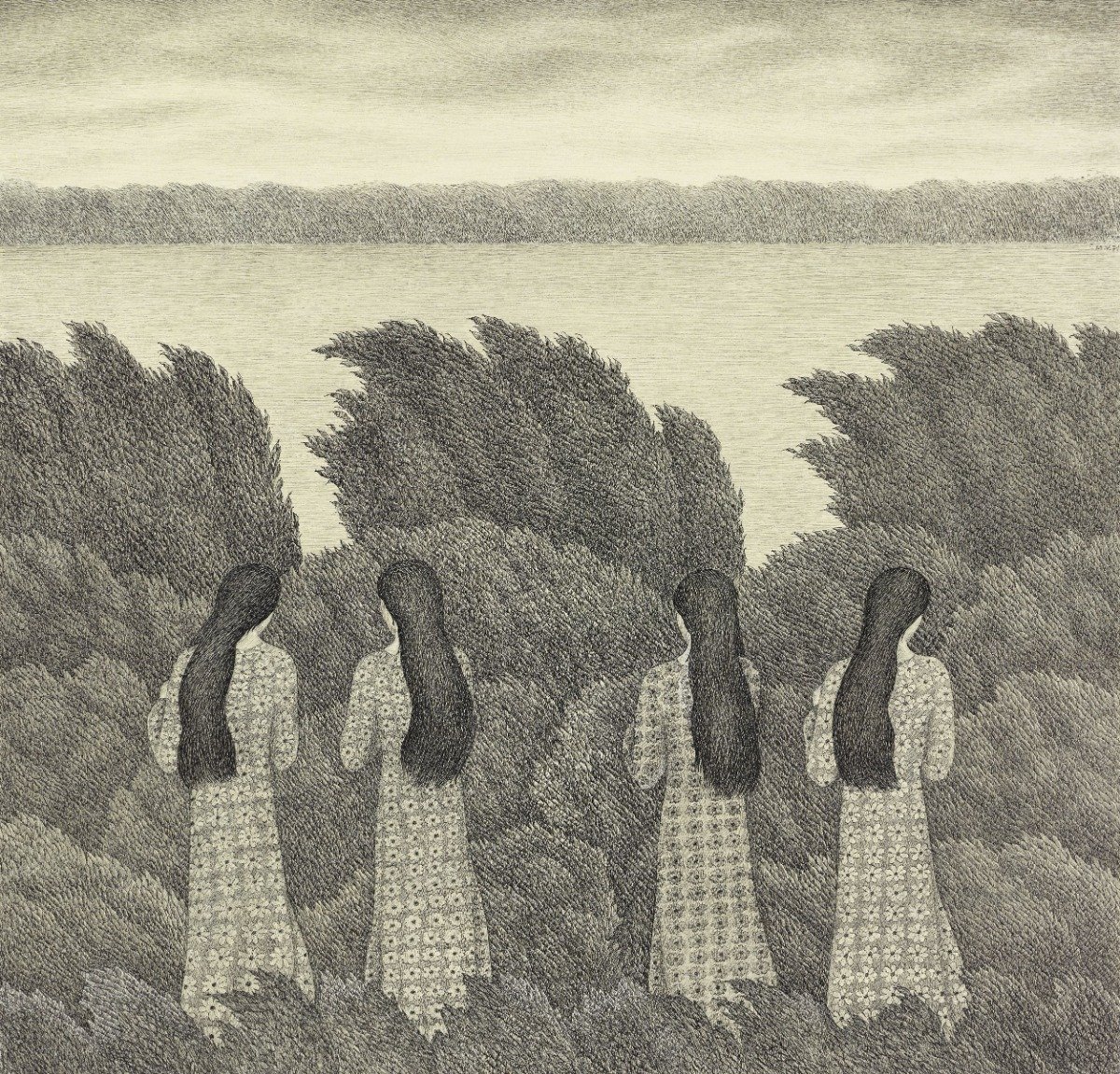
Born during the German occupation and raised under Soviet rule, Mare didn’t find her home country of Estonia liberated until the artist was already mid-way through her 40s. Under strict control, most of the Estonian coastline was even off-limits for fear of escape (another landscape emptied of humans, under highly refined control). I can almost imagine the vast emptiness of these depeopled coasts found their loneliness into Mare’s landscapes. Far from the official socialist realism long supported by the communist authorities, one’s also moved to wonder the effect of state sanctions in this outpost of the Soviet empire what effect the rules of art and society had on these restrained masterworks. The austere simplicity of man-made structures whilst nature maintains its detailed intensity. The symbols of either capitalism or socialism utterly disappear, perhaps they are both just other ghosts haunting the empty space. Though Mare’s pictures lack any direct political references, their blankness and quietude hint perhaps at politics off the frame. Though Mare was still a toddler when World War II ended, it is estimated that over a quarter of the population of the country perished during the war, leaving behind an emptiness not easily filled. The silence of her pictures is perhaps a silence of preferring to say nothing in the face of ideology. This is all just speculation, the pictures are perfectly quiet about their perfect quiet.
In her tableaux, this perfection invites mystery. Like the surreal murders drawn in Peter Greenaway’s The Draughtsman’s Contract (1982), one looks for clues in their both austere and lavish majesty for a sinister plot. But perhaps the mystery isn’t something so pedestrian as a murder but something more like the enigma of De Chirico’s metaphysical landscapes, a riddle as deep as existence itself to which there is no solution. Both familiar and otherworldly, the mystery perhaps is in us, the madness of our ideals and the unruly force of nature even so artfully contained. A search for balance that weighs the heave of absence against the messy gravitas of presence. I’ve wandered long in Mare’s empty gardens and cities, looking always for some hint to unravel the mystery of their silence and never finding the key to the puzzle. And so I wander on, lingering in the intricate foliage and hard geometries inventing elusive memories and elaborate stories, always tantalizingly out of reach.