A letter is a short story
—James Lee Byars, letter to Toni Gerber, 1975
You can't ever look straight at James Lee Byars.
The glimmering color of the peacock is the trick of a feather, built just so, layered and angled, catching the light to combine and bend at a shifting glance but never truly sunk into any one color. James Lee Byars is like this.
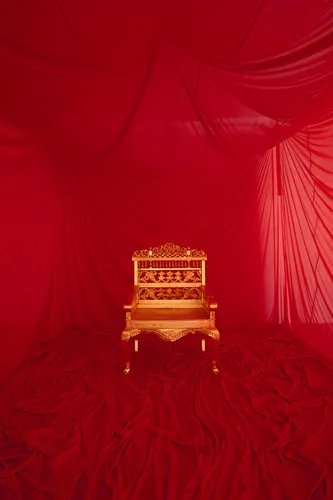
There's some trick he does, a shift of his eyes, a sweet shimmer off his top hat, the light slippery on his black suits and gold lamé get-ups, the heavy glasses (eyes are too intimate says JLB), some combination where he's there and not there at the same time. Astral projection, perhaps stoned, or one of his goofy grinned performances under luxurious silks and gilded rooms, spaces and seats for contemplation and sanctuary and letter reading, always and ever a Perfect Death. In his Autobiography, the 1972 film shows only complete darkness until JLB clad all in white appears for a fraction of a second. For all his billowing spiritual power and flittering fame, he is only a momentary flicker in the void.
If James Lee Byars didn’t exist, we would have to invent him.
His friend and advocate Thomas McEvilley recounts an interview with JLB for his first big article on the artist for Artforum: “Evincing impatience with the prosaic, clerical approach, he exclaimed, ‘Oh Thomas! Just make me up!’”
James Lee Byars was a real charmer, a darkling dandy, a magician, a Zen Baudelaire, a cheap circus barker, an ebullient evangelist for the ethereal, a self-made exotic from some Michigan dullsville, a showman, a shaman, a faker, a fraud, an inveterate writer of letters and a maker of perfect bonbons for collectors keen on Japonaiserie by some Western weirdo to add to their baubles and fetishes, a true poet and according to some a real asshole. James Lee Byars is what in the 20th century came to be known as an artist.
One of the stories of JLB, surely true, was the declaration by Guggenheim director Thomas Messer recounted by McEvilley of a retrospective he was trying to start up at that institution. The artist insisted that the entire museum be painted matte black. "To give Byars a show would be to destroy my museum," Messer said. "I'll give him a show when he is dead."
One of his deaths was a room gilded simply and totally in gold.
One of his last works, an arrangement of glass globes blown by a master glassmaker, each globe a single breath, arranged in the shape of an angel.
It seems wholly fitting that James Lee Byars the man died held hostage by creditors in a four star hotel in Cairo, Egypt, the first capital of Eastern mysticism for Westerners seeking arcane knowledge and esoteric answers.
The artist was of course more interested in questions.
Though he staged his death many times, James Lee Byars’ final performance resulted less in the death of the man and much more the demise of his imaginary.
At least half of the stories about James Lee Byars are false, or more politely and perhaps more accurately, embroidered.
On many official and officious documents his first exhibition is listed as a solo at the grand Museum of Modern Art in New York in 1958. Is it true that he road-dusted from hitchhiking charmed his way into a conversation with the curator Dorothy Miller? This is entirely possible as a paper trail of letters followed this meeting for years, JLB asking for help and jobs, courting always with kind words, letters often bearing exotic stamps from far Japan where the artist lived on and off for nearly a decade and some say became inspired by Shinto ritual and Noh theatre.
Did Miller grant him an exhibition of perhaps a few hours in a stairwell? This is a bit hazier.
Did Philip Johnson and other NYC grandees come and purchase pictures? Perhaps. Johnson did donate a work by JLB from this time later on. Some intrepid sleuth has traced down evidence of this. But MoMA otherwise has no evidence in its archives of this exhibition. But if you go now to any of JLB’s galleries, look at any book that lists his exhibitions and there it is, unfettered and unquestioned, a doughty line unblinking from his curriculum vitae, ready to defend against any niggling doubts, in black and steady ink under the heading Solo Exhibitions—1958 Museum of Modern Art, New York
Even without such stories, he has better ones. Actions like fairytales. One day in the 1960s, James Lee Byars released 100 pink helium-filled balloons to rise towards the moon. In 1967 in Los Angeles, JLB handed out ten thousand round sheets of white paper, each printed with the message: A White Paper Will Blow Through the Streets.
For these two acts alone, I love the work of James Lee Byars.
Legends are always thus.
I also love JLB’s work because he allows me to love the sensual and the ethereal simultaneously.
Some sensualists can empty the object of their affections of all heart, head and soul.
Those committed to the cults of emotions, intellectuals, or spirits, drift out of reality, forgetting the pleasure of food or that fucking has its own magic. Fingering marble and thrush of silk on skin feel good. So does knowing they’re just stopovers on a much grander abstract adventure.
Neither professors nor businessmen satisfy what I need art to satisfy, and the art world these last years has felt an either/or proposition. James Lee Byars is both and neither, brilliantly so.
A tamer of beauty, a crafter of perfect things, closed and inward, complete, somewhat silly perhaps, but always only receptacles for a long and searching life.
James Lee Byars’ grand and generous spirit frees you to physically love the things that he made. Finely crafted out of precious materials, he makes their sensual textures and glistening skins, seem like they’re pure material, their undeniable simple selves carved into spheres, folded carefully, gilded with gold, and spread loose and smooth, each and always was and is perfect. Is JLB an old Zen master, the kind to slap you in the face, giggle, fart, and prove with each rudeness the utter perfection of the universe? JLB was always after perfect and always found it. Though not offered with a question mark, the last book in the series of 100 One Page Stone Books, 1977/1978 asks “Do you think there could be two perfects.” In Theravada Buddhism, there are ten. Plato said ten was the perfect number. Pythagoras preferred six. Aristotle wrote in Metaphysica that something that is complete is perfect, nothing to be added or subtracted. In the Physica, the tutor of Alexander the Great declared that the circle was "the perfect, first, most beautiful form." In 1985, JLB answered his own questions perhaps in crafting The Book of 100 Perfects.
Perfect of course is more about intention than result, but JLB loved circles and spheres. He once wrote NASA asking them to take into space a flag for the planet to be permanently displayed on a satellite circling the earth, a perfect gold circle, twenty-feet in diameter. NASA declined. Though in 1982, JLB presented one to the former president of the Explorers Club in New York. During the presentation, McEvilley played an eight foot long brass Tibetan temple horn, its sound meant to represent the void.
This all got reported in the New Yorker, Talk of the Town section.
From JLB, March 1978:
statements
1. i'm a mystic
2. ask my best
3. i write the world's simplest poems
4. i think so
5. philosophy is news
6. thinking is my first quality
7. glimpse is enough
8. the only prerequisite is that you should be excited about something
9. you can say anything about anything
10. hypothesis doesn't exist
questions
1. which questions have disappeared?
2. i can repeat the question but am i bright enough to ask it?
3. if you ask for something that doesn't exist do you deserve it on the intelligence of the request?
JLB’s perfect objects made of Thassos and Blue African marble, labradorite granite, red lava, cut into spheres and crescents, enclosed in glass cabinets with scrawled gnomic messages are ancient relics from collapsed civilizations meant to inspire some sense of material and perfection, the meeting of reality and ideal in beauty, the realization of such making a suffering life more subtly endurable, the highest crafts of an inspired people.
They are also totally cheesy. Circle, sphere, column, marble, silk, gold, red, pink, and black. Crescents and beauty and question and perfection. These are titles and images off a self-help rack at the local New Age bookstore, the gaudy flash of empty esoterica. They are crackpot dreams of a society broken by its own repressions, in a decadent age of mysteries and mystics holed up in small rooms to hear stories from speechless stars. A joker with a lunatic assurance in his own mystic quest. A holy fool. His objects fake relics from an invented religion. JLB’s stone books bear resemblance to the tablets Joseph Smith pulled out of a hill in upstate New York, quickly lost, that made for the basis of what some people call Mormonism, a made-up religion now millions strong.
All religions are made-up of course. So are their relics. Gilded in gold and left to age in grand halls, all things grow holy.
Carved from stone, JLB’s objects will easily last so long. Imagine them in two thousand years in some great hallway of a museum devoted to the relics of the great, collapsed American civilization, what stories will anthropologists weave about them? What cult will they say these objects are relics of?
You could say I guess that the cult was Conceptual art. JLB stood on the ethereal end of that spectrum, where dematerialization became more spirit even than pure idea, though some might say the two are indissoluble.
A cult of one led by a charismatic drifter and dreamer named James Lee Byars, perpetually caught between Question and Perfect.
The Perfect Love Letter Is To Write I Love You Backwards in the Air,
performance by James Lee Byars, Cathedral Square, Gallery De Appel, Amsterdam, 1975.
This letter is written backwards with wind on water, blown across the continent we were both born on and over an ocean to the sloshy lagoon of the Venice he lived in often, to the long and lithesome Nile cutting through the land that holds his bones.
The 97th of his 100 One Page Stone Books reads: I CANCEL ALL OF MY WORKS AT DEATH