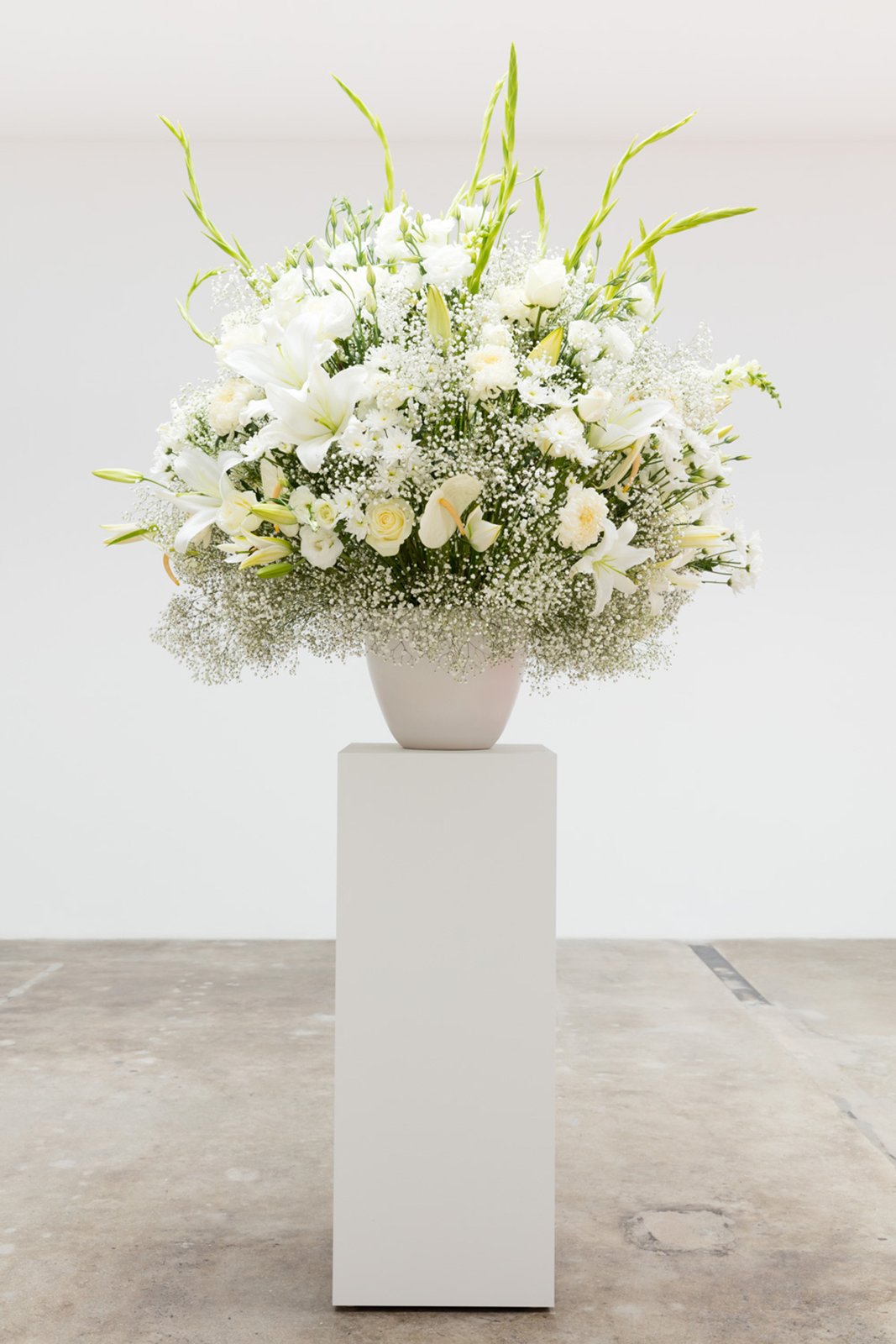
Without flowers, the reptiles, which had gotten along fine in a leafy, fruitless world, would probably still rule. Without flowers, we would not be.
-Michael Pollan, The Botany of Desire (2001)
Not even the category of the portrait seems to have ever attained the profound level of painterly decrepitude that still life would attain in the sinister harmlessness in the work of Matisse or Maurice de Vlaminck... the most obsolete of all still-life types...
- Benjamin HD Buchloh on Gerhard Richter’s Flowers (1992)
Don’t worry, nobody’s looking. Go ahead. Stop and smell the flowers.
Feel that sumptuous perfume blooming from those spreading petals, that’s pleasure. That’s sex. That’s the body lotion of the teenage beauty fingering your belt buckle to take your virginity (or the one you wore when you tugged that belt off your first). That’s your grandmother’s bathroom and the heart-shaped wreath at her funeral. That’s the lithe fingers and supple wrists of the florist, an emperor of blooms arranging the flowers for your mother just so.
Those petals, that scent, those colors.
Somehow flowers have become a decrepit subject, “the most obsolete of all still-life types” to use Buchloh’s words. Despite the eminent Octoberist’s antipathy (and he is hardly alone in his disdain), flowers in art are back in bloom.
Flagrantly frivolous, wholly ephemeral, though ancient in art, the floral’s recent return as a major subject for artists marks a pivot towards those things which flowers represent: the decorative, the minor, the ephemeral and emotional, the liveliness of their bloom and the perfume of their decay, a sophisticated language of purest color and form that can be both raw nature and refined arrangement, poetic symbolism rubbing against the political mechanisms of value, history, and trade. Flowers are fragrant with subtle meanings, each different for every artist who chooses them as a subject. They are a move away from literal explications, self-righteous cynicism, and towards what precisely? Let’s say poetry.
Free in the wilderness, rowed in gardens, bouqueted on tables, a decorative aromatic around the dead, flowers offer an opportunity for a simple, sensual pleasure, both a temporary escape and corporeal return. Their origins as a species are a bit shrouded in mystery, but most who study flowers and evolution agree that they came about in order to employ insects and animals in their reproduction. (A process that surely continues with our artful interventions). They lure with beauty, eventually tricking humans into agriculture and the dream of making such fecund and lively yearnings permanent, into art.
First and foremost, flowers are the sex organs of plants. Those bright colors and elaborate bodies were meant to turn us on. Georgia O’Keeffe transformed her blossoms from still-life representation into a kind of abstraction that tongued that first truth of flowers, each of her blooms wore the faces of interdimensional pussies. Robert Mapplethorpe’s photographs of flowers look even more suggestive to me than some of his more obviously lusty snaps of men in various states of undress and erect action.
Though their flounce and curve have a pornography of color, flowers as a metaphor can be easily read as safe, sanitized stand-ins for the real musk and squelch of sex. A vase of flowers in grandma’s parlor might be of less notability than a bouquet of dildos erupting out of a bucket of lube. The opposite of badass to all the tough boys playing with their power tools, flowers for them are for old ladies and sissies and girls. Macho minimalists preferred stacks of bricks and sheets of steel to prove the heft of their seriousness. Besides the florals too comfortably bourgeois for the shock and spectacle of self-serious avant-gardists, though Giacomo Balla’s Futurist Flowers (1918-25) look as radical as anything else those defiant Italians cooked up. Though flowers have been found in art for thousands of years, first evidenced in funerary motifs in the earliest Egyptian dynasties, they’ve been used mostly as sideshow, a decorative motif, a signifying prop. But around 1600, during the time of the tulipomania that rubbled the Netherlandish economy, Dutch artists began to paint blooms as the main attraction, finely wrought bouquets with delicate strokes, an idealistic botanist’s attention to perfection and detail, each variety laden with meaning, some held-over from religion, some made-up with each newly invented varietal. This efflorescence came about with the disposable income of the bourgeoisie and the introduction of the tulip through international trade with the Ottoman Empire, where, in the court of Constantinople, flowers were all the rage. As an object of desire and prestige, the flower earned its worth as a central subject.
By the Victorian era, the language of flowers became wildly popular, that repressed period needed something sexy to finger, especially for the corseted women. The frivolity of flowers perhaps an area of knowledge the patriarchy let ladies have mastery over, but male artists weren’t ignoring the chromatic potential of blooms either. With wet smears and hazy visions, Vincent Van Gogh and Claude Monet were amongst the best floral daubers of their time (with a solid shout out to the drooping beauties of Henri Fantin-Latour, whose painting A Basket of Roses (1890) made it on to New Order’s 1983 album Power, Corruption, and Lies, itself an elliptical Richter reference). Flowers to these painters made for a way to explore the power and range of their medium with unfettered color. “Perhaps I owe it to flowers,” said Monet, “that I became a painter.” As art took an intellectual turn however, flowers fell out as serious subjects, the provenance of Sunday painters, bourgeois domesticity, appropriate only for the marginalized. As those outsiders increasingly collapse binaries however, the center cannot hold and vines snake into the heart of power to bloom a variety as diverse and beautiful as the spectrum of humanity.
A recent exhibition organized in Los Angeles by curator Chris Sharp called “A Change of Heart,” at Hannah Hoffman Gallery in Los Angeles this past summer touched on dreams and contemplations I’d been having about the nature of obvious forms of beauty and their force in art as both assertion and escape. Sunsets, moonlight, waterfalls, and, of course, flowers, all easily dismissed as sentimental kitsch, seemed to be having a new life, a self-conscious Romanticism that acknowledged these subjects as perhaps decayed and misspent, but let their beauty sweep them up anyway. In “A Change of Heart,” Sharp states in the press release that the work in the exhibition “embraces the floral still life in all its formal, symbolic, political and aesthetic heterogeneity [...] a radical and even dizzying diversity of approaches, including the queer, the decorative, the scientific, the euphemistic, the memento mori, the painterly, the deliberately amateur and minor as a position, and much more.”
From historical works by Andy Warhol, Alex Katz, Ellsworth Kelly, Jane Freilicher, Felix Gonzalez-Torres, and Bas Jan Ader, to art made much more recently by Camille Henrot, Willem de Rooij, Amy Yao, Kapwani Kiwanga, and Paul Heyer, each of the artists in “A Change of Heart” approach the floral in wholly unique ways. Rather than cordoning off the artists in Sharp’s excellent show, I’m going to weave their methods, ideas, and visions into a larger conversation, some of which were quite likely on the curator’s mind, as any art gallery and its resources can only be so expansive. In London as well, gallerist and curator Silke Ritte-Thomas has opened up a project space and store front called TukTuk Flower Studio to site the floral visions of contemporary artists.
Of course some artists in recent history focus on the base, mass-appeal of flowers like Warhol with works like his iconic screenprint Flowers (1964) and Jeff Koons with his giant, bloom-encrusted Puppy (1992) and solid shimmering metal of Tulips (1995-2004). But despite the blank-faced games of pop cipher employed by Warhol and the spirited industrial-scale exuberance of Koons, I can’t help but find a whisper of contempt in both, a pandering, just hucksters giving the people what they want. This obviousness and its exploitation is of course a part of the story of our modern interactions with flowers, but this quality belies the subtlety of a more nuanced story.
Though beauty as a notion has so often by capitalism been turned into kitsch, as Milan Kundera puts it, “a denial of shit.” We can find this modern kitsch in the unblemished bloom on the cheeks of a Disney princess, America’s most popular artist Thomas Kinkade’s creation of an imagined past of perfect old-timey townships, a good old days that glosses over all the problems of inequality and oppression endemic to that era. Donald Trump is the kingpin of this kind of kitsch these days. The best of our feelings can be easily hijacked for political purposes, but it is a mistake to cynically dismiss those feelings simply because others would take advantage of them.
All aspects of creation are beautiful enough to need little human improvement, including flowers. As John Berger writes in The White Bird, “The notion that art is the mirror of nature is one that appeals only in periods of skepticism. Art does not imitate nature, it imitates a creation, sometimes to propose an alternative world, sometimes simply to amplify, to confirm, to make social the brief hope offered by nature.” Our attempts to capture the power of these moments aren’t to improve upon them, but to fix their power, to make ephemeral hopes and desires into something more permanent. Perhaps, the natural and the man-made is one more collapsing binary, and the diversity of flowers allows for such wild variety that the simple monolithic subject of ‘flowers’ can’t easily contain it. In using flowers as a subject, artists have gravitated to specific modes, from the classic still-life (like Richter on the ass-end of Buchloh’s anti-floral sentiment), the entwined poetical and political meanings, their elaborate symbolic language, and as a pronounced shift of the decorative margins to the center, traced in the atmospheric floral patterns of Marc-Camille Chaimowicz (enjoying a fantastic resurgence of interest), the pastel squiggles of Lily van der Stokker, and the softly erotic washes of Paul Heyer. Pulling the margins into the center has also of course been one of the great political projects of our time.
The poetical/political intertwine in flowers have a few, significant contemporary precedents. Felix Gonzalez-Torres imbued common objects with profound poetic and political force throughout his work, and included in “A Change of Heart,” the artist photographs the flowers on the graves of Gertrude Stein and Alice B. Toklas. In a single snap, an almost slight touristic photograph, the artist reveals a nexus of forces around flowers, as memorial, as assertion of love with all its political and artistic forces, the floral as vaginal given their lesbian sexuality, and as a visual poem that matches Stein’s “A rose is a rose is a rose…” itself of course an invocation of Shakespeare’s “A rose by any other name would smell just as sweet.” A rose is a rose and love is love, by any other name.
With a blend of flowers sometimes artificially constructed beauty and his own indexical variety of sharp critique, Christopher Williams’ work on flowers takes a more distinctly political focus, working wholly on reclassifying a collection of flower models (fakes to be clear) not into botanical hierarchies but into political relevance. The photographs of Angola to Vietnam (1989) snap pictures of selected replicas from the Harvard Botanical Museum's Ware Collection of Blaschka Glass Models, made between 1887 and 1936. Williams however focuses on flowers from countries where political disappearances were recorded in 1985, reclassifying them by country of origin rather than by the museum's system. But though these are certainly flowers, one gets the feeling Williams wants to undermine their bourgeois beauty and the colonial impulse that collected, modelled, and classified them.
This sharply political act finds force in the work of other artists: Taryn Simon’s photo series Paperwork, and The Will of Capital (2015) and Kapwani Kiwanga’s ongoing series Flowers for Africa (begun 2012) focus on floral arrangements found on the tables and banquets of important political moments. Simon’s photographs tend to flatten the arrangements into manipulated environments, whilst Kiwanga’s living bouquets with their intention that they rot over the course of the exhibition (I watched one wither in “A Change of Heart”) find a complex and physical poetic. For Kiwanga, the flowers that stood on the tables of important moments in politics stand in for the colonial import of European flower arrangement, where, for what, and by whom these flowers were cultivated, but also the hope and heartbreak involved in many of these agreements, some a marked turn towards liberation, other accords withered along with the flowers. (Both of these projects echo to me Danh Vo’s display of the chandeliers from the Hotel Majestic in Paris that hung over the agreement that ended the US-Vietnam War.) Zoe Crosher’s billboard series, Shangri LA’d (2013-5), produced in collaboration with LAND, displayed a lush array of flowers and greenery arranged by the artist and shot in a storefront formerly occupied by the Chinese Communist Party in Chinatown. As one drove across the country on the transcontinental highway, I-10, the flowers rotted further with each successive picture, a decayed brown mass greeting the traveller as they crossed into California and onto Los Angeles, a dream of prosperity and possibility decaying as the ideals that drive a traveller westward become the hardships of the road and the realities of place.
For the last decade, Virginia Poundstone has included in her artwork all aspects of floral cultivation from their turn from the natural to the artificial, climbing the Himalayan mountains to find the most wild of wildflowers and travelling to the factory farms of Colombia and tracing those industrially grown blooms from growth to auction to wholesalers to flower markets and shops. Her interest grew from a day-job as a floral arranger and her research into the gendered origins of that craft in the West and its resonance as a mode of artmaking from Japanese ikebana to her curating alongside her own work at the Aldrich Museum floral works by Christo, Nancy Graves, and Bas Jan Ader ( his video, Primary Time, 1974, of endless arrangement that’s also in “A Change of Heart”) that have informed her deep investigations and the complex symbolic value and language of flowers.
Other artists focus primarily on this language. Willem de Rooij’s Bouquet series (first begun with his late collaborator Jeroen de Rijke in 2002) employs this language to speak instead of literal language, discussions around politics are followed by meditations on color or a collection of blooms gathered for their intensely allergenic qualities. His giant displays, in contrast to Kiwanga’s, are carefully restored throughout an exhibition, a florist collaborator in each of their iterations regularly visiting the exhibitions to maintain the scent, color, and freshness of the expression. In “A Change of Heart”, Chris Sharp includes Camille Henrot’s ikebana interpretations of important modern novels as well as Maria Loboda’s A Guide to Insult and Apathy (2006), that attempts using the symbolic language of flowers to insult their receiver.
For flowers, the recent turn holds an echo of Romanticism, the intuitive, the emotional, the poetic existing alongside a belief in political freedoms. Lusty poet Lord Byron died in the war for Greek independence. One of the fundamental human rights is a right to pleasure, to beauty. To assert beauty isn’t our collective ignoring of the hard struggles of the world, but rather an assertion of exactly what we’re fighting for.
As Fernando Pessoa writes in The Book of Disquiet, “Flowers, if described with phrases that define them in the air of the imagination, will have colours with a durability not found in cellular life. What moves lives. What is said endures.”
A Blooming Addendum
Amaranth / #E52B50
Amaranth never fades in the perfect embrace, though all things fade after.
Lips stained by unutterable fruits, of pinched nipples pushing back, of a distant swirl in a fading western sunset, a color between the sun and the land where the two come together in bright union, one burns out the other in an evanescent sigh of amaranth.
Why do pinks always feel so light? It only takes a tease of pink to make a white sheet go red, but amaranth is a little richer than that. Amaranth is creamy, breastmilk pinked with blood.
Amaranth is ancient Greek, roughly translating as the unfading flower, the bloom of which is where the color cribbed its name. The Greeks associated it with immortality and the gods, as its bloom lasted year round undiminished by the changing seasons.
Amaranth the color is not an idle pink for Miami Beach suits and Disney princesses, no tea cosies or kitsch, cotton candies or Mary Kay compacts, it is never to be found on the toothlessly girly, the flippantly louche.
Amaranth has the timely grace to exit the party at the perfect moment.
To split early is to miss the peak, the moment the exuberant energy of mere party crests above all the walls and partitions, the formalities fall away, and the raw open force of human-life coalesces into legend.
To stay too late is to take away all the lipsticked cigarette butts in your mouth and all the broken bottles in your bones. To leave at the right moment, everyone is sad to see you go but understands that all good nights have to come to an end sometime, to leave too late is to slink out, friends give curt, preoccupied adieus, distracted by this or that, the babysitter or the morning commute, that their wife has been talking to that girl for much too long, that they’ve again had too many drinks or they aftertaste the cigarette that broke the promise of quitting.
To depart at the right time is to take away all the dynamism and hope for days afterwards, to leave your companions with the memory of the moment, still radiant, a luminous memory they can take out on darkish days.
You can be off by only minutes.
Sometimes it’s never a good time to leave and you hang on forever.
Amaranth is more the color of the right moment. It is the clear blush, the epiphany of knowing the moment in its fulness.
Milton, Shelley, Coleridge, and Keats all wove rhymes with amaranth. For Milton this undying flower hangs from the tree of life.
From Aesop:
An amaranth plant, whose flower never fades, had sprung up next to a rosebush. The amaranth said, 'What a delightful flower you are! You are desired by the gods and mortals alike. I congratulate you on your beauty and your fragrance.' The rose said, 'O amaranth, everlasting flower, I live for only a brief time and even if no one plucks me, I die, while you are able to blossom and bloom with eternal youth!'
Low and slow, amaranth burns long.
Lily White / #F3EFE0
It's purity like an insult.
Perhaps we're past the time of purity, the romantic ideal food for fascists, excuses for moral scrubbings and racist lynchings. One of the movements trailing the Civil War in the American South was called Lily-White. Its purpose was to disenfranchise the new black electorate. Its symbol on a farmhouse meant it was a safe place to plot, one account has them organizing over 200 lynchings, strange fruit.
Lily white. A nickel phrase used by fledgling poets, always followed by skin. Another byword for purity, unblemished ideal a built-in tragedy. A hothouse flower easily withered. Though I've chased the ghosts of too many ideal girls, a few of them lily white, delicate beauties, rough hands leaving bruised fingerprints on pale skin. You might as well put the noose around your neck as soon the lust raises its head, such purity requires sacrifice. It's better to crave adulterated women, mixed race, mixed background, mixed words, mixed dreams, mixed media, moderately immoral, often fierce, proudly impure, in other words, real.
William Blake sings the praise of the lily:
The modest Rose puts forth a thorn,
The humble sheep a threat'ning horn:
While the Lily white shall in love delight,
Nor a thorn nor a threat stain her beauty bright.
But I prefer the thorn and horn.
A mutt is a unique breed, stronger for its melange of genes, the tooth and nail of wild curs. I pity all the pure breed dogs cultivated for this or that by the lonesome, idle rich, some kind can't even birth without doctors on hand, their designed hips too narrow to squeeze a pup. I want the Westminster Kennel Club to make a category for most beautiful mongrel. They won't of course, that dog would eat the rest alive, squirting its impure seed into every perfect bitch, the females taking on every pedigreed pooch strong enough to mount such a hard and reckless lover.
The lily is hardly pure, even the Easter lily, the ideal of the "pure lilies," Lilium longiflorum, the bright white of its outer petals contours to creamy yellow at the stamen. The shade above reflects this creaming, a dollop of hot chroma destroying the sanctity of the whiteness. Lily white names a spectrum of colors, either as here creamed or in other taxonomies, it’s a bleached out blue, but we'll draw ours from the flower.
The only instance of lily white seeming sexy is when a long-winter skin, stripped free of clothing in the spring at the edge of a snowmelt pond, the first glimpse before the sun sinks its rays in is sometimes lily white, but even here it is its ephemerality that gives it beauty, a naked body ready for a wet swim, the play of freedom, a momentary idyll after the hardness and scarcity of a mean winter, finally broken with a splash, the ripple spreading across the stillness as a lily white ass disappears into the depths emerging soaked and sun kissed, happily adulterated with water and light.
Nothing stains the lily’s white because nothing ever touches it. Once handled another, richer color is born.
Orchid / #DA70D6
GEN. STERNWOOD
The orchids are an excuse for the heat. You like orchids?
MARLOWE
Not particularly.
GEN. STERNWOOD
Nasty things. That flesh is too much like the flesh of men. Their
perfume has a rotten sweetness of corruption…
The Big Sleep (1946)
The shape of this flowering plant’s pendulous doubled root ball suggested to some ancient Hellenic botanist the particular danglers in a man’s kit, and orchid got its name from the Greek word for testes. Thus the dainty beloved of aristocratic gardeners and fussy flower breeders are buried balls, dirty nuts. Try not to snicker when granny effuses, “ I simply adore orchids.” Flowers have always been symbolic of sexuality, and even more so for those for whom it’s suppressed. Women, especially older ones, have been forced by social norms to staunch their desires, rarely granted the allowance to fuck freely. It gladdens the heart in its own weird way to hear old folks homes have the highest transmissions of STDs these days. Not because it’s good for anyone to catch the clap, but because it means they fuck with more abandon than most might care to admit.
To some, orchids make the sexiest of flowers. Their namesake roots lie buried in most variants while those strange blooms pump horticultural hearts with lively colors, generous curves, and lusty orifices. If vaginal decoration took a sharp surgical turn past bejewelled vajazzaling, you might find yourself confronted with one of these psychedelic pussies when dipping down for a French lick. As flowers, they fall into an uncanny valley. Too close but not close enough, the effect is just creepy rather than alluring. Whilst other flowers invite an inserted nose, a huff, and though not yet an erection, their floral perfume has turned my head in that general direction. But the fleshy orchid does not inspire my lusts even a little. Perhaps even an opposite, its odor and form the absence of body, a dry thing with a funereal odor.
“Crypt orchid” is the term for an undescended testicle, though I dream a flower that can only blossom in tombs.
The bright, rich purple creeps its name from the flower, one of innumerable possibilities for a plant with wild variation. Though it has the crackle of electricity beneath its buzz, orchid’s too muted to be much beyond a suggestion. Bright but not the brightest, rich without being creamy, orchid’s a faded purple haze on a bright day, the fading neon of a strip club past its prime.
Rose / #FF007F
A rose is a rose is a rose is a rose.
When a beautiful rose dies beauty does not die because it is not really in the rose. -Agnes Martin (1989)
Each five-petal-kiss of colors from the tangled, toothy green stems. A broken-hearted smear, a yearning expressed through the formality of its presentation, the rose’s simple obviousness is its charm. The color of nipple, just exposed before cold air and hot mouths harden it into a deeper shade.
In many languages, the word for ‘rose’ and ‘pink’ are the same.
Rose-colored glasses. Roseate glow.
Rose tints my world
Keeps me safe from my trouble and pain.
-The Rocky Horror Picture Show (1975)
Ask any florist and he’ll know how much a dozen will cost, one extra thrown in for luck. The rose grows thorns to better climb over its neighbors, to push over other flowers hungry for a beam of sunlight. More than one rose has drawn my blood, the dripping finger quickly mouthed.
Rose, floating in the pond, a dead flower in the eddies of the silver surface spangled with light. A lover’s bathtub blanket, a romantic’s bedspread. Rose, a gesture, an empty signifier, a lover’s lament, a husband’s apology. A shapely scented flower, a dream of what pussies could be.
Flowers and fruits are the sex organs of plants. Georgia O’Keeffe knew surely what she was doing with her folded blooms, plumped petals peeled back. Victorian ladies corseted by rigid morality spent repressed hours devotedly fingering their carefully cultivated flowers. Fresh blossoms will wilt on the vine whether they are nabbed or not. Gather ye rosebuds while ye may, you virgins who make much of time. The scientific term for wilted plants starved of nutrients and water is ‘flaccid’.
A lover once told me she only enjoyed flowers knowing that something was dying expressly for her pleasure.
Every rose has its thorn...
Flowers began as a funeral tradition to mask the odour of a decaying corpse. Wreathed, bouqueted, and sprayed, apple blossoms and heliotropes, chrysanthemums and camellias, hyacinths and delphiniums, snapdragons and of course roses. Anything goes for funeral flowers, just so long as they are fresh.
One artist I know dreamed of casting in concrete the castoff flowers at the bottom of a Soviet war memorial. All the original flowers she stared at for hours, snapping picture after picture, measuring and admiring the perfect war memorial, the waste of pageantry all heaped and rotting, all the showy pomp to be swept up and trashed. Failing to gather them all from a park one Sunday afternoon, she made a memorial to that one. Under marbles carved Pro Patria, sometimes you'll find flowers, but you'll be sure to find a corpse.
“Roses," she thought sardonically, "All trash, m’dear.”
― Virginia Woolf, Mrs. Dalloway (1925)
As bright blooms fade, what is the color of decay?
Is it a sinking brown, a pale green, a mouldy black that captures the wilted flower, the rotten fruit, the decomposing body? Spotted and mottled, both wet and dusty, alive with death’s critters and aromatic with rot, the color is unsteady at best, a hue with a checkered future. Tuck a rose away, let it dry and though the life goes and the color fades, its form remains.
Ah Little Rose -- how easy
For such as thee to die!
-Emily Dickinson (1858)
I won't forget to put roses on your grave.
Goldenrod / #FCD667
Highway 395. No other cars for hours. In the distance, a road block, a white truck, a helmeted man. The worker, subcontracted by the feds, told me to wait awhile. They were destroying fugitive armaments leftover from WWII off the road. Too old and too volatile to recycle. Not the first bombs to kiss this desert.
Alongside the highway, tiny yellow desert flowers peeked from rocks along the gravelling asphalt, somehow mysteriously watered by the sweat of passing cars. The size of pupils, an ancient aroma, the color of a geriatric sun: a stooped wisdom, ready to retire. Beyond the yellows, just shrubby dirt for dry miles until the cliffs. Perpetual surprise in their broken bodies, stripped naked in the sun. Nature caught towelless, I’m never displeased by the vision.
A trio of kabooms with three mushroom clouds, three new scars cut in the unforgetful desert. The worker waved me on, a clutch of wildflowers on my dash, windows peeled down, raspy air sucking through the car, loose hair licking and spitting, dust on my tongue.
Poppy / #FF6907
Come on home. The poppies are all grown knee-deep by now.
Blossoms all have fallen, and the pollen ruins the plow.
—Joanna Newsom
California. Say it slowly now, soften the edges and let it drawl out. A hard latinate grown smooth in the ocean like bottles polished by the sea.
It is a buttery avocado spooned onto your tongue, oranges tumbling out of a sack onto the linoleum floor, a gaggle of jetplanes swooping over the giggle of bikini clad girls on the beach below. It is barren hills festooned with bright orange wildflowers, the California poppy. Wildflowers bloom where they will, no gardener can control them. They are the state flower for a reason.
To Okie farmers dusted out of land by bankers, the word was like the tinkle of rain on thirsty fields. When they said California it was like teeth breaking the skin of a freshly plucked plum, its juice dribbling down their chins.
I left for freedom. It was an imagined country but I loved and feared it. I learned the separation between reality and the imagination is permeable, so much as to not truly be separate, but intertwined like the limbs of lovers.
Traveling so fast over the land, I left behind California and its dreams, tires like zephyrs, the flickering gas stations and truck stops more luminous than stars. I left in airplanes, window blind closed to all the land being left behind. I left on trains, heavy metal wheels slipping over the continent on infinite tracks, heading east and north and sometimes south, every direction but home.
I came back alone, my plane ticket riddled with punctuation errors. Though California flickers with ghosts and shadows of collapsed fantasies, the light failing like a broken projector, it is still no more yielding but a dream.
Everything grows here.
Lavender / #B57EDC
Lavender is the color of forgetting.
Firstly, a flower and more than that, a scent, but here a color. Later perhaps, the three may separate. Here, they are wholly indivisible.
Purple spikes in over 39 separate species and 400 cultivars, the flowers of this mediterranean mint lent their name to the hue. They sprout in bushy arrays close to the ground with leaves usually feathered in pairs off the stem, hairs heavy with aromatic oil. The whole plant emanates the scent of lightness, of forgetting.
Lavender is difficult to remember, all memories fall out. The color tumbles out of a box packed with the culinary flower, a gift to someone past gifting, it drifts from my mother’s boudoir, where the floral notes hide in rifled drawers trying to divine who she was, who mothers were, who women were, it spills from bottles like jewels that line the body shops, each a soothing palm, a smoother of crumpled time, a fresh breath for the striated gasps of aging, for all the hardships that wear heavy on our faces and around the iridescent flecks in our eyes. We rub our bodies with salves and put droplets of lavender salt in long hot baths and we dream of what might be, the reborn quality we are gifted when our memories go away.
The word for lavender either comes from Latin words for washing lavare or livid/bluish livendula. I like to think of the forgetful flow of lavender as a kind of a wash, the water taking away all the accumulated history and grime, and leaving one cool and clean, scented with an aroma that could only ever be safe, soothing, forgiving. Forgetfulness is that way.
The land of the lotus eaters I’m sure was bathed in lavender.
Forgetting’s always foggy some say, a heaviness, but the best forgetting is clear, so clear everything past is obliterated: gone, disappeared, a landscape barrened and renewed leaving only the thrush of purple flowers and their feathered leaves.
Clean and soft, some call the scent of lavender intoxicating, but it doesn’t make its lovers lose control as much as forget controls or that the desire for control ever existed. This soft soothing touch of this pale indigo cleans rather than poisons, though lavender’s amnesia perhaps hues both.
Most colors lope into language from nature, only later do they advance to abstractions, cut cleanly from earthbound origins. The amethyst stone, the bruised sky, the lavender flower. Their poetry vanishes into the blunt force of ‘purple:’ a color only truly appropriate to people eaters, Princely rain, Hendrixian hazes, and the hearts of wounded soldiers. Lavender, however, is lavender is lavender.
Lavender is the steam of soap, the oil run through clipped hair and the breeze from fields passed by on summer roads, a blush of pale purple, a sigh of beauty. Lavender is queer shorthand of course or straight shorthand for queers, reclaimed and repurposed. No better way to reshape radical future than to wash away the past traditions in the soft waves of lavender.
Lavender is a very dangerous color. Too much soothing and we grow petty, easily spooked, terribly rattled by small variations, ever more ensconced in the safety of our scents, immune or at least hateful to other colors.
I have already forgotten so many memories, purposefully. Pain washed away with pleasures, whole years blanked. Is it better to forget, to learn to forget, to set our faces deep into the lavender bushes and fade into new pleasantries, history a mountain behind the horizon?
Passing through the veils of lavender, all origins are forgotten, and only loose atmospheres linger, memories like scents, disappeared in everything but spirit.
Lilac / #CBA2CB
I lost myself on a cool damp night
Gave myself in that misty light
Was hypnotized by a strange delight
Under a lilac tree
I made wine from the lilac tree
Put my heart in its recipe
It makes me see what I want to see
and be what I want to be
When I think more than I want to think
Do things I never should do
I drink much more that I ought to drink
Because it brings me back you...
Lilac wine is sweet and heady, like my love
Lilac wine, I feel unsteady, like my love
(1950)
Pale purples are the fucking saddest. Lavender’s forgetful wash. Mauve’s lonely decadence. And Lilac. The color of unwilling resignation to lost passion. The pale fade, a lost spring.
APRIL is the cruellest month,
breeding Lilacs out of the dead land, mixing
Memory and desire, stirring
Dull roots with spring rain.
- TS Eliot (1922)
The lilac flower originated in the Croatian coast from hence it found its way into the gardens of Turkish emperors and from there to Europe in the 16th century, not reaching the Americas until the 17th. The scent of lilac has become for many the scent of spring. Carried by indole which is also found in shit, lilac’s aroma carries with its fade a special decay, heavy and narcotic. To a nose that does not know the tricks of the master perfumer, indole dropped in chocolate and coffees makes the product smell natural.
A note found in perfume, bottled spring, often worn by elder ladies.
In the Descanso Gardens in Los Angeles, they have a forest of 250 varieties of lilac, their names a horticulturist’s poetry of yearning: Dark Night and Sylvan Beauty, Snow Shower and Spring Parade, Maiden’s Blush and Vesper Song.
I missed their bloom this year, gone to the snowy mountains where the flowers blossom late, but to walk amongst the towering shrubs is to be punched in the face with perfume. So sweet, so heady. Running my fingers over its heart-shaped leaf, failing to feel my leaf-shaped heart. I dreamed of going there with my lover and went there many times after she left me. Dreaming of her. Feeling the sweet sadness of her perfume, the unwilling resignation of her love withdrawn. And this lover, all the lovers who always go away.
One lilac may hide another and then a lot of lilacs - Kenneth Koch (1994)
Whitman dropped a sprig on the passing coffin of a murdered president and birthed a poem for dooryards and students. Not his most beautiful by far, but its love is real. As any love for a distant leader can only be so real, but the lilac is love. Staring into a screen full of its color, I am both spring and its destruction. Its bright lovely burst of life, its wilt and loss. The cool kiss of night, naked skin shivers but still you stay. And you stay and drink its sweetness and its rot, you drink your heart.
In the desert
I saw a creature, naked, bestial,
Who, squatting upon the ground,
Held his heart in his hands,
And ate of it.
I said, “Is it good, friend?”
“It is bitter—bitter,” he answered;
“But I like it
“Because it is bitter,
“And because it is my heart.”
- S. Crane (1895)
Cherry Blossom / #FFB7C5
A Selection of the Traditional Colors of Japan;
or, Bands I Wished I Was In
Cherry Blossom
Ibis Wing
Long Spring
Dawn
Orangutan
Persimmon Juice
Cypress Bark
Meat
Sparrow brown
Decaying Leaves
Pale Incense
The Brown of Flattery
The Color of an Undried Wall
Golden Fallen Leaves
Simmered Seaweed
Contemplation in a Tea Garden
Pale Fallen Leaves
Underside of Willow Leaves
Sooty Willow Bamboo
Thousand Year Old Green
Insect Screen
Rusty Storeroom
Velvet
Harbor Rat
Iron Storage
Mousy Wisteria
Thin Color
Fake Purple
Vanishing Red Mouse
Half Color
Inside of a Bottle