Comic Strip Gaze, Cosmic Ship Grays, Ceramic Slip Glaze: From Henri Matisse to Betty Woodman
What I dream of is an art of balance, of purity and serenity, devoid of troubling or depressing subject-matter, an art which could be for every mental worker, for the businessman as well as the man of letters, for example, a soothing, calming influence on the mind, something like a good armchair which provides relaxation from physical fatigue.
--Matisse, “Notes of a Painter,” 1908
Sit too long in that armchair and the wallpaper will creep. The mundane stillness of domestic parlor games for bourgeois businessmen, the stagnancy of air plumped with stale tobacco-smoke and roast chicken and potpourri, the numbed-ass stasis of sitting in that comfy armchair, hour after hour, year after year, and the wallpaper will creep for sure.
Vines undulate and tangle, roping their way through the windows, the glass webbing into conjoined shards, its translucent body refusing to fully shatter. Fat, thickening green arms vein over the ceiling, the plaster crackling and dusting, sprouting tufts of leaves that hydra into arms of their own. The pouched lips of pods perch above the bookshelf and peel back to unsheathe ornamental daggers with poisonous jewel petals, the colors so sumptuous they can only mean death. But even from that comfy armchair, those colors itch to be tongued, the daggers throated, a dangerous little Bonheur de Vivre.
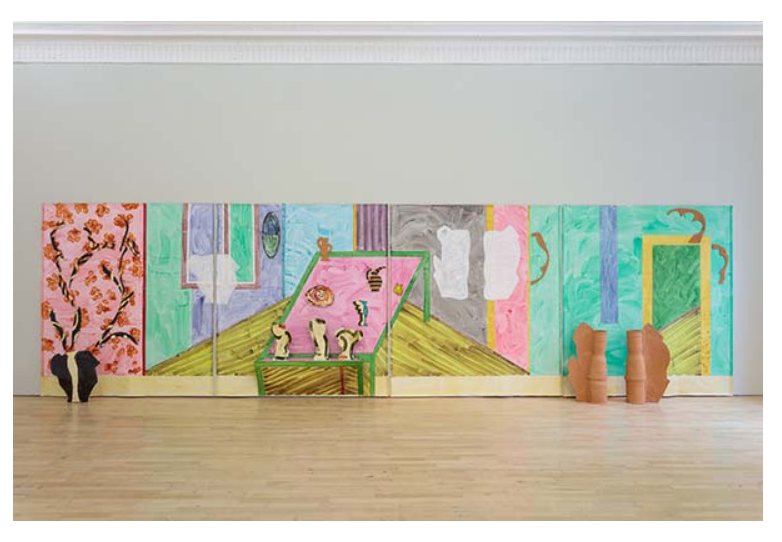
Betty Woodman has made more than one unruly wallpaper, the scraps of ceramic dance in patterns along the wall, each swathed with paint. But even as a canvas painter, her paintings are never flat-faced 2-D tableaux but whole rooms. Matisse always wanted his cut-outs to hang pinned and not glued to the wall, so that they could curl off like sculpture (museums for the sake of conservation paste their unruly curls down). Dispensing with paper, the bright stony swirls of color of Betty Woodman jut with glassy glimmer off the wall, they’ve gone beyond paper.
In this room, white birthed a brood of color, each a chip off the old beam, prismed out into unique forevers, literally radiant. The pure, scattered hue skitters throughout the room and in their unfettered flight might as well be birds. The carpet boils, the wood slats crumble to mulch and the threaded Persian filigrees sprout, joining the cacophony of life bursting in this drawing room jungle.
The vines are trees, the trees a jungle and the wallpaper tatters, the walls disappear into fetid wet trunks, each waxy leaf a sharpened tongue, and even the slightest movement makes them lap like a dog’s, dripping with hunger.
Our armchairist thinks it’s a garden and we let him.
The chief function of color should be to serve expression as well as possible…. the icy purity of the sour blue sky will express the season just as well as the nuances of foliage.
--Matisse, ”Notes of a Painter”
For me, a colour is a force. My pictures are made up of four or five colours that collide with one another, and the collision gives a sense of energy. When I put green, it doesn't mean grass. When I put blue, it doesn't mean sky.
--Matisse again, interviewed by Pierre Courthion, 1941
Betty Woodman is a slatherer. Hardly a straight line or a precise corner finds its way into her wriggling lines, her color has all the reckless joy of drunken, fistfighting rainbows. In her color sample vases, like Double Color Sample Vase from 2011, smears of color each named circle the ceramic. The impulse to collect them all in a messy array that has some jokey action towards a complete spectrum is an attractive impulse, like directing different fireworks into a canvas of clouds. We cannot compete with the stars but we can manage to concoct our own explosive bursts of colored light when those celestial bodies are hiding.
The regal procession of a warrior queen passes through the gnarled and roped tree trunks, her sunkissed handmaidens wear gold daggers cinched to their waists, breasts bound with the pelts of jungle cats and wildebeests. Plump odalisques with inviting forms, but a hungry hand might quickly regret taking these warriors for concubine slaves. Any daring to finger their concupiscent curves might not sense their arm’s chopped clean till it wetly smacks the earth.
Each of the queen’s handmaidens drips with decorative jewels of jasper and jade, ruby and sapphire, carrying in their arms a particular treasure from a wide and ancient world. Greek amphorae and Etruscan oenochoes, Korean celadons and Tang porcelain, glass tiles flowing with arabesques from Mecca and Alexandria, mosaics from Teotihuacan, Rome, and Byzantium and Lapita burial urns nabbed from New Caledonia, Turkish embroidery and kabuki masks, Persian carpets and Indian miniatures. Her highness’ taste tended toward glass and ceramic. If to the patriarchy women were like sand, then their heat had transformed her tribe into glass, glittering in beauty and sharp as necessary. If made from clay thought to be so easily molded, she would fire her women into stone with hardened skins and flaunting colors.
Functional concerns have really become conceptual. Vases are now about vases.
-- Betty Woodman
It probably started out as a simple vase. The vase seemed incomplete, lonesome, it needed friends. Piece by piece, with architectural flourishes, random swirls and imaginary plinths, details of a house emerged. Climbing up more than 20 feet up the naked white wall, it is not quite a house, just enough to see its shape and color. The vase did not so much as find its House in the South, 1996, as made itself the perfect home. If a vase is just a container, then why can’t a room or a house be a vase too?
“Too Matissey,” a woman complained while viewing the spectacular Betty Woodman retrospective at the Metropolitan Museum, a show that, on the day that I saw it, piqued a good deal of chat among strangers…. None of the work is too Matisse-like. Though the master of color is very much evoked, nothing could less reflect his ideal that art should be like a good armchair than Woodman’s rough-and-tumble theatricality.
Peter Schjeldahl, “Decoration Myths,” The New Yorker, May 15, 2006
So the vase became aware of the table, the table became aware of the room, the room became aware of the house and when the house becomes aware of its people, it becomes a theatre. The vases in Theater II – The Rockettes, 2001, are Busby Berkeley beauties strutting their stuff down a grand staircase, each shaking its unique curves. The theatre is a slow one though, it takes a few human lifetimes for them to shake a leg, but they are all primed and ready should time crack-shatter them into movement or an earthquake dance them off the stairs.
The Queen arrives and that armchair bound adventurer can not quite see her. His eyes fathered this fuckfest of color, but he can no longer control his creations. They are wild things like their father in his fauvist youth.
Hours pass. Then they are not hours, they are millennia. The continents shift and the oceans rise, seawater seeps into the room and the hot air cools into languid liquid, the trees make ways for the slowdance of seaweeds and the fish slither their bodies against the long, loose stalks. Other creatures, their names just divers’ jokes and Latin colorings weft their way in, fronded bodies like long-fingered hands that soak and suck their way across an ocean. The handmaids transform to mermaids, no less fierce for their fins. The man turns ultramarine and with a long and beautiful thrash of limbs suddenly loosed from time, he cyclones the edge of the room, then swims away in a burst of blue.
Brilliant colors are important as part of my material. My first response in any artwork is to material. I'm a great admirer of Matisse; for an artist my age, it's hard not to have been influenced by him. For years, I stayed away from his work because it was too attractive. Now I'm mature enough to commit myself to it.
--Betty Woodman, interviewed by Vibhuti Patel, Wall Street Journal, May 7, 2013
Betty is loose and fearless and committedly whimsical. She takes a form and bends it till it’s a woman, a man, a pillow, a window, a room, a theatre. She’s a magician that can turn that lump of clay into just about anything. From wherever she began making simple earthenware pots to her current travels through the wild frontier of a swirling kaleidoscope, the movement was ever beyond, to the furthest edge of what her simple pots could become.
The ocean recedes, the room returns, but this comfy 19th-century parlor has been warped by its metamorphoses. It is now a clay-dusted studio with a kiln and a half-century of bravering craft. The queen remains, undiminished in strength but more mother than killer with the flowering of time, her conquests settled into the care of glass and clay and flow of pure color that can sometimes be found in paint, lustrous and crackled, abstract and figured, ripe with laughter and ponderous pauses. Unruly as her warriors though, they refuse to only carry water or cradle the dead, they climb the walls and stack into pyramids in loose painterly joy. With limbs spread-eagled, they wear their sexual freedom with exquisite grace. The slathery colors wash over shapely bodies, and they prance and gambol with theatrical flourish and unfettered joy.
Brush in hand and kiln at the elbow, our queen crafts an army of irrepressible pots that would be sculptures that would be pictures that would be rooms, just like this one.
There isn’t an armchair to be seen, only Betty Woodman.