She’s Like a Rainbow: The Colorful Aili Vint
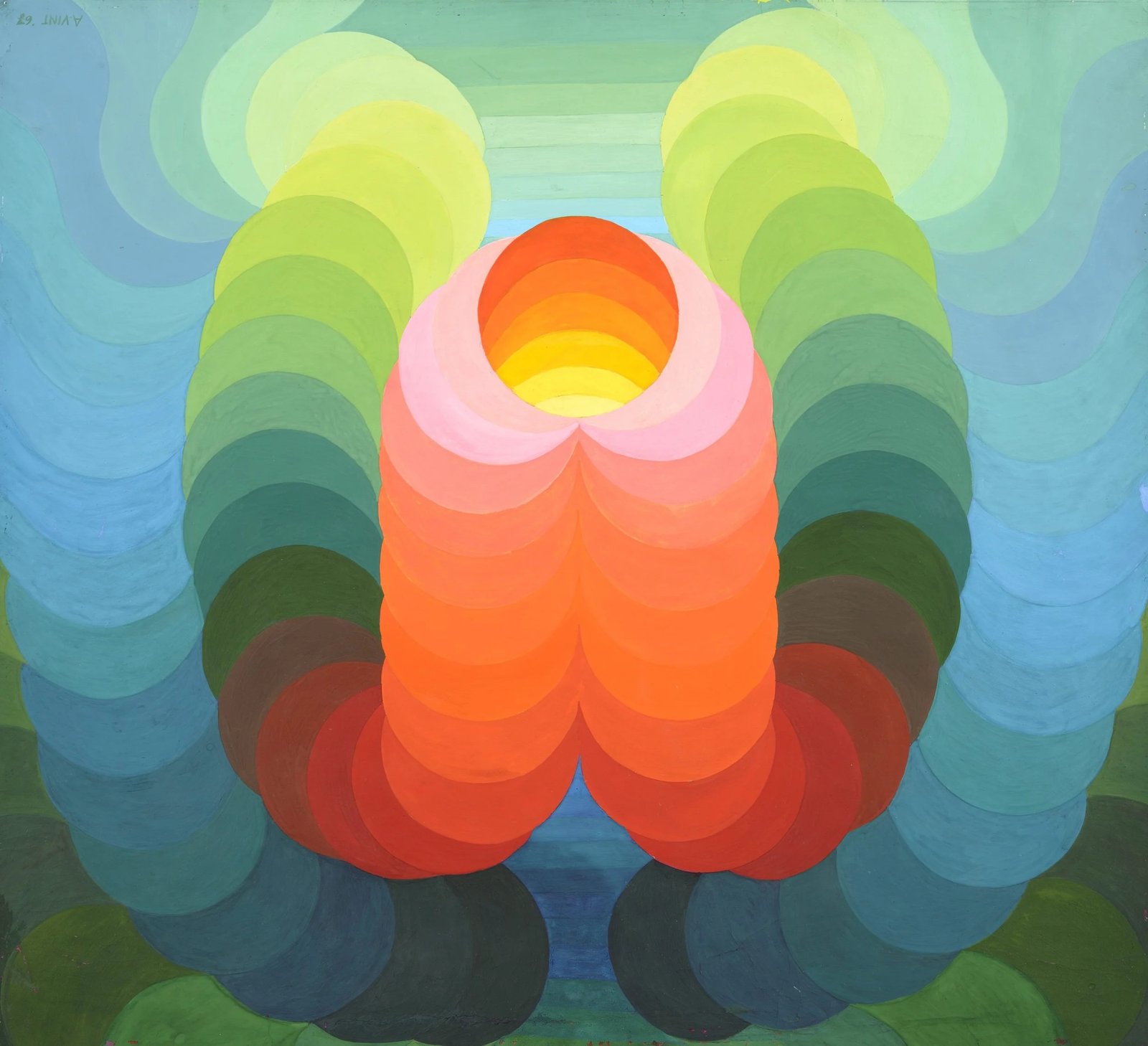
Luminous caterpillars of shivering color, the sumptuous curves of mirrored bodies, layered atmospheres almost too ethereal even to be carried by hot chroma until you spot a figure there padding along the shore of its otherworldly hues. Walls weep in dreamy sky rooms and water, a sheer shimmer, liquid fantasias and rippling reflections, never the same twice but here stained permanent with pigment. Look long enough and the sea splish-splashes with a wave of cool spray straight into your eye. Pure light paints the water with heavenly hues, sheering across oceans with every dawn and dusk.
Erotic blossoms stripe and lick, all this color is so sweetly 60s, like listening to Strawberry Alarm Clock on just a little too much blotter, where you can actually believe that peace maybe has a chance. These saturated hues blow and bend into diaphanous sculptures, curled and folded and winking like they may beam you into other dimensions, straight past any waiting room bardo and ever further beyond. Like Cummings says “somewhere I have never travelled, gladly beyond”. Beaming sunset psychedelias made by and regularly inhabited by female badassery.
Though it’s easy to break out a thesaurus for the spare few words to say colorful, none of them can capture the vivid beam and burn of pure color, sopping and saturated, crystalline and depthless, and even when adulterated, so purely itself.
I am sliding my eyes through the oeuvre of the Estonian artist Aili Vint with an especial pleasure. Born in Rakvere in 1941, Vint is most simply an Estonian painter and graphic artist, but her cavalcade of colors summon my wholly intangible spirit to leap headfirst into her pictures.
Perhaps as Aili Vint leapt out of the sandy seascapes and shadowy forests of Camille Corot, aged nine.
Corot painted The Curious Little Girl around 1860–64. There she is, weighted and freighted with heavy layered green dresses, hair elaborately braided atop her head, hands resting on the crumbling wall in front of her. But she is turned toward us, that is the painter, with a severe expression, determined, unflinching, as she dares us (Corot, anyone) to stop her from springing over that wall like a rainbow. Vint saw herself in this girl. She found her in “an ancient, dusty, and completely broken book in the attic,” its torn pages printed in black and white. The girl who would later become such a colorist met her first masterpiece without a lick of it.
And what is on the other side of that wall?
In retelling her life story, Aili Vint remembers another picture that beamed in reproduction from the wall next to her bed (a wall which might be perfect in all ways, but also crumbles in my imagination). In it, the tower and curl of waves splashes with divine light, crashing down and around some rather desperately shipwrecked sailors clinging to the remains of a mast. So small in that oceanic grandeur, you almost have to squint to see their totally desperate situation.
Painted by Ivan Aivazovsky in 1850 as The Ninth Wave, the wet force and awesome powers of nature, still gleaming with light, left its details in the deep churn of her own wet spirit. As a child, Vint remembers crawling around the rip and churn of those waves in her head instead of nodding easily into that good night.
How many pictures of beauty filtered in and around Soviet Estonia? Perhaps pre-revolutionary Russian things not deemed too terribly counter-revolutionary, and the long march of Socialist Realism across the academies. But I also envision pictorial samizdat: lurid abstractions and Western decadence passed about like dirty playing cards. In fact, with the young artists of ANK ’64, Vint found her way into that traffic: lectures on foreign artists they organized themselves, ties to the nonconformist undergrounds of Leningrad and Moscow, the KGB keeping watch. They made their own abstractions too, showing their bursts and swirls secretly outside officialdom.
But Corot and Aivazovsky gave her pictures you could somehow enter, beauty and the sublime summoned through paint, the first sparking light of all that came after.
Before either of them there was another picture, a child’s glimpse waiting on the other side of the rainbow, maybe. Vint remembers being eight and watching the sea at sunset, feeling that she and the sun were painting it together (which in some biological sense is true), then worrying that the sea was simply too darned vast to ever fit into a canvas.
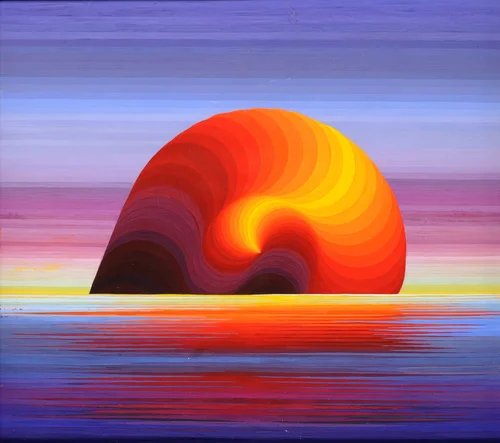
In Sunset of 1969, she gives it a try anyway. A great orange-red form swells up from the horizon, nested in itself like a shell, a cosmic furnace, with unblinking yellow burning near the tightest curl. Mystic violet-blue air sighs above. The water catches what it can below in strata of broken horizontal stains. The whole picture feels too large for its paper even while sitting there perfectly well inside it. The sea can never fit. Its color spills all over you anyway.
As her daughter Eva-Maria remarks on the artist’s wholly delightful and gleefully autobiographical homepage, which is where I gathered these many flowers from her life, with succinct charm: “In any case, she’s a very colorful person.”
Colorful is the right word, meaning naturally “full of color” in its first and simplest turn, but it also surges with “variety”, is soaked through with “interesting”, and at times just a tease raw, as in “Please forgive my colorful language.” (Those mirrored nudes I alluded to at the start are aptly titled Variety Delights; and though not as chromatically drenched, they sop with other pleasures surely).
For those, Vint worked from a photograph of a naked woman and a mirror, splitting and doubling the body. Flesh goes ornamental, floral, abstract, then suddenly flesh again. The etchings are both flesh and fleshless, pure light, but damned if I don’t feel the pulse of life in their shades.
Though not all the policemen in the world can hold back the colors of Spring, getting your hands on the means to reproduce it, well, that can sometimes depend on luck.
Joy and Catastrophe (two titles from her cheerful Pop, both 1967) swim with polychrome gouache. As Vint tells it, she was the lucky lottery winner of the single box of Dutch paints that had arrived for Estonian artists, and she did not waste her pigment. All that color strips off its pretensions like the most erotic of dancers and with prismatic glee swims across the paper. A whole economy suddenly bursting out of a little box: the color itself scarce, rationed, won by luck, then squeezed and slathered with abandon.
Though I can only imagine the industrial grays and potato browns of the SSRs, Tallinn’s 60s was not San Francisco’s 60s, even if some of the colors seem drunk enough to have stumbled betwixt them. Books slipped through, music found a way, rumors traveled, images stumbled badly and beautifully through all kinds of censorious filters.
A hot swirl and spill of color leads to a rainbow, that arcs and bends right through the picture plane and into the landscape. And of course color can always do this, if we let it, but here in these sharply striped strata that make up the world in this picture, the rainbow graphically, literally leaps out of the picture.
She began by making color misbehave, then bodies and the sea, though the sea had been beckoning to her since childhood.
And then I remember Corot’s little girl that is really Aili Vint, hands on the wall, daring us with her stare.
It is only a painting really, more oil on cardboard laid down on wood. But to mark material alone would be like describing the love of your life as just a bunch of cells held up with bones. The picture is whatever we need it to mean. The little girl can be any of us, our daughters and mothers, or for me now, an image of Aili Vint ready to jump a wall.
And the wall?
It is anything that holds back the women and girls of this world, bounds them in. Whether it be a glass ceiling or an iron curtain, or something more sinister because it can be so hard to see it. Vint came of age as a woman artist inside a Soviet art world that decided which pictures could appear in public at all. When her sensual prints were finally approved for an exhibition in 1974, fellow artists plotted to stand in front of them with their wives, blocking the view, while one of them talked the officials past. One misstep and she might have been thrown out of the Artists’ Union, and then there wouldn’t be any more paint or canvas to buy.
The wall can be that separation between us and the artist, between the edges of the picture and what imagination can bend beyond its borders. However static a picture is, it can leap out of the frame and grab you by the throat, splash you wet with its hues the way that 1969 sunset spills off its paper, portal its magic into the mundanity of an everyday room, and portal us out of the ordinary.
The world within and the world without, the separation is only one of perception, a kind of an illusion. Just a bunch of artfully arranged stardust. In Vint’s own writing the sea has a soul; there is an invisible connection between nature and our senses; sometimes she goes so far as to write, simply, “I am the Sea.” But we can cower inside our bodies, behind the limitations of our skin and forget that we are it and it is us.
And so her categories keep getting wet. Sky runs into sea, sea into light, light into body, body into abstraction. The later paintings become almost perfect sheets of water you might pass through, another wall to beam through and over.
I have this tattoo I got on a lark that says “Once Again As Ever Free.” A reminder scarred in ink that we are always free, even if it is easy to forget. And we are free even when we are the least; someone, Mary McCarthy maybe, I can’t remember who, once said that even a gun to the head is an invitation.
But I need reminders, reminders that I’m a part of this wild experiment, that beauty surrounds and engulfs us, that every day the sun sets and splits its light into a thousand and one colors across clouds that laugh endlessly in their heap and curl over human borders. And the sea and sky are always churning between each other and through me, one of the many curious creatures made mostly of water.
Maybe that is why I keep coming back to the little girl and the wall. A rainbow punches through a landscape, a naked body doubles and blooms. The sea still won’t stay inside the paper. Seventy-something years later the sunset is still throwing its color around a room somewhere.
The girl has her hands on the wall.
Now what is on the other side?