Greetings from Beautiful Ader Falls
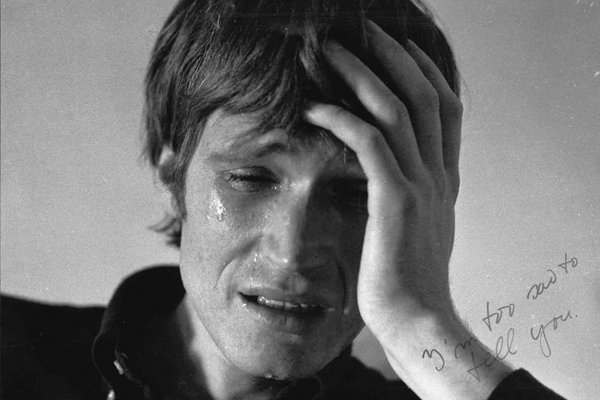
In one of his notebook entries, Ader jotted an idea for a postcard: “Greetings from Beautiful Ader Falls.” More ominously, he wrote, “All is falling.”
Bruce Hainley, “Legends of the Fall,” Artforum, March 1999
A tired township in the far western hinterlands of New Amsterdam, the village of Ader Falls resembles a half-finished sand-castle, speckled and windblown, construction abandoned as its towers, townhouses and tract homes were being erected. Though inhabited, it smells mostly like an outpost that, even half-baked, could’ve been something much grander if time hadn’t finally run out. Though spare and modern by design, the village has taken on a mantle of wistfulness, the air thick with metaphysical musings, like an ancient civilization long since collapsed, yet still more advanced than the current culture.
The denizens derive their spare cultural understanding from a set of mail-order prints of Dutch and German masters (from sweeping Caspar David Friedrichs to a flyspecked Mondrian) hawked at the local general store by their proprietor (who once had a Dutch uncle) with a bourgeois flourish. A lone radio station spins the sadder, dreamier songs of ’50s hit machines on slow revolution, making the jingle and pop of bubblegum wheeze and murmur along like a funeral hymn.
There’s a photobooth outside the general store, the kind that spits out four shots, black-and-white, for a dollar, but the snaps are always abandoned, the pictures taken always make the sitter seem so sad. Though sadness can imbue a man or woman with the beauty of its depth, one does not like to remember oneself burdened with such tragedy.
The residents, unharassed, except by time and accident, live day to day in a series of simple gestures, movements stripped of unnecessary meaning and performed with a present-tense, deadpan seriousness normally reserved for soldiers, comedians and recently recovered alcoholics. They may occasionally finger through dog-eared copies of Reader’s Digest, but only to linger overlong on the disasters. Having come to Ader Falls from difficult and strange stories abroad, following shipwrecks and nervous breakdowns, after chasing one chimera or another, ultimately broken from their lost and gone beloved, they have finally found a place to look for what cannot be found. Residency is, and has always been, fluid, its history written on water with wind.
Ader Falls is an upstate New York hamlet on the edge of Southern California sprawl, a phantom truck stop often (if not always) missed on the long, lonesome midnight interstate between Los Angeles and New York City. But the lights of Ader Falls do flicker at nightfall and the meager few townsfolk find that when smashed with a stone, most lights will go out.
Founded (like so many heartlandish American townships) by a ne’er do well adventurer and dreamer, a brooding European prankster, who died young, Ader Falls harbors an unusual share of drifters and grifters, cons so talented they deserve the additive cognomen of “artist.”
Ader Falls has no waterfall, at least not any waterfall that we would consider anywhere near the words “majestic” or the sensually bureaucratic “voluminous” which often get appended to Niagara. But things do fall there. People from trees and houses. Rocks onto lightbulbs. Often, tears.
Perhaps the most notable feature of this nondescript burg is its unique relationship to gravity. In Ader Falls things fall. Not the Yeatsian gyre of things falling apart nor the imperial Roman arch of a rise followed by the inevitably deflationary fall, but the curious gravitational calibrations of reality being regularly tested with humor, and its limitations a cause for mourning. Gravity blankets the hills like a forgotten curse, a curse that inspires hope in breaking gravity’s laws with jocular, thigh-slapping hope and always foundering, despairingly.
The townspeople can be found weeping in the streets, at their jobs, behind desks and countertops, at the factories and shoe stores, their tears dripping into lukewarm cups of coffee and on freshly printed receipts. A tourist to Ader Falls might venture to ask the lachrymose population the cause of their powerful sadness, but they are unable to squeeze a word out through their melancholic wheezes. Spend too much time there and neither will you.
The weeping can begin at breakfast, an off-hand comment that cuts through all the morass and callousness of modern life, just a few trickles over runny eggs and golden brown toast, the kind of tears your tough old father would weep at the recounting of a World War II sea battle, but the trickle mounts and by lunch, it’s a torrent. Standing up from their leather roll chairs, grabbing the wall for balance as they stumble out into the streets, the weeper begins to laugh at their terrible situation (the only retort for tragedy being comedy, as everyone knows). But the two (the laugh and the cry) get stuck together, like when one tries to breathe and drink at the same time, and the two get mixed and the swallower/breather would begin to choke uncontrollably. Red faced, wet-eyed, face convulsive.
The laughter/weeping in Ader Falls could continue all day, or like a sudden change in the weather, disappear as slinkily as it came, traveling beneath the surface until the next day or the day after it would return: as a sob or a snivel, a whimper, a whine and a wail, inevitably dropping to the desperate release of bawling, before descending at its nadir to embarrassed blubbing.
As if the town were built on a well of sadness, the people of Ader Falls weep with abandon, a freedom lost on everyone but children or the desperate. Seeing another resident weep, you might start weeping yourself, or laughing at the ridiculousness of a town of people who weep, and start laughing so hard that tears come to your eyes and once broken becomes weeping.
Periodically, denizens, drifters and pilgrims get inscribed into the annals of local lore like how other towns might honor their native sons and daughters as football stars or war dead. Those notable few of Ader Falls have performed duties and rituals, actions and gestures which define the civic soul, there are no statues in Ader Falls, but their names have currency in the city’s precincts and are passed around in hallowed whispers.
Sebastian Stumpf, who hailed from Leipzig, Germany, bootstrapped his way to Ader Falls as a freelance gravity-tester, though he had occasionally acted as calibrator and deconfounder of other environmental factors in his long career. He has, regrettably to his various, previous employers, taken his tests a little too far for the stuffy bureaucrats and tiresome grandees involved in the sensitive, political work of gravity determination. The people of Ader Falls welcomed him as a native son and he is currently employed by the township for his particular abilities.
Fernando Sanchez, smuggled into the country as a baby, has found some way to channel the wretched boisterousness of the world, like a raging river through the phone lines and fiber-optic cables into a simple set of gestures that make falling seem like the only thing left to do. So he does. Ader Falls welcomed him.
Artemio gathered up all the weeping he could, like collecting lost kittens from the alleys of Hollywood. Each mewing cat, a scene from some lost actor finding a way to produce, even force, tears that fall so easily in Ader Falls. One can try not to let other people’s crying affect one’s own, but it’s impossible. Every time one sees another weep, a little bit of their sadness is caught, a mild disease, not one that will likely kill, though it could. It’s a disease that lives in one’s house, its feet padding through bedrooms and kitchens, the mimicry of woe inflects our own. The people of Ader Falls often shed tears, and can’t help but think of these stray images, collected by Artemio, as they weep.
Martin Kersels, the biggest man to ever visit Ader Falls, tests the limits of gravity with every step. Though attempts to bend reality have resulted in him catapulting friends as test subjects. His results, however, have been inconclusive, and Kersels has accepted gravity, and he falls now often and with joy.
Kate Newby has never been to Ader Falls, though they’ve adopted her as honorary citizen. She sends plaintive telegrams to the town, sent in care of the city itself. The messages are so gentle, the telegrams get folded up and stored in the city’s archives, reread on holidays, though occasionally they are buried in parks and industrial yards. One or two has bloomed, the gentle buds are cared for like children.
Piero Golia passed through Ader Falls only briefly, en route to disappearing. Though only in the town fleetingly, his disappearance was so total and complete when he finally accomplished it that he left a permanent unfillable space in the town. The space, known as Golia’s Gap, is the closest thing the town has to a monument. A few who wish to disappear walk through it at every opportunity, they’ve yet failed to replicate his act, though they do tend to lose focus for a variable time afterward. Perhaps superstitiously, most everyone else avoids walking into the space, always around it, lest they disappear too. One never knows, now does one.
Gonzalo Lebrija only ever passed through as well. But in Ader Falls, people only ever pass through, many leave a residue of their ghostly passing, though some leave stronger traces than others. When Lebrija ran through town, he seemed to be onto someplace else, trying to close some distance, trying to make his way past what cannot be passed, his loneliness stuck to the town forever, all echoing footsteps for those far from home in Ader Falls are the footsteps of Lebrija.
Thiago Rocha Pitta’s steel boat came to town filled with water, the water gave him his shape and he was unable to leave it lest he lose his way. The boat, crusted with salt and wear, was dragged by some secret fire he burned with a chemistry set that looked like an old-fashioned compass and the trappings of an apothecary, the glass bottles filled with swirling purple and green liquids Pitta stole from a passing storm and bonded with his own reveries. He dreamed of the ocean, from which he would always be parted, susceptible to drowning as he was, as we all happen to be.
Jed Lind brought a boat too, an unfloatable lattice work he hoped to take down the falls, to capsize in the white spray. There was no snowy foam of water, no riparian splashes, so he left it in a place where at the very least it might be wet by the rain, having never expected to sail it anyhow, as if the impossible journey had already occurred, it sailed with each cut of the carving knife to shape the unfloatable boat. When the wind sweeps through town, it whips around the boat and blows a long, low whistle like a distant train.
Diego Teo came through town in paint-splattered trousers that could never get dry. He tried to paint portraits but the paint, never dry, would get covered up before it had a chance to settle. He painted a mural one night, leaving before morning, the paint is always shifting and changing, never able to settle, never able to stop moving, filled with a wanderlust for other pictures.
Most of these adopted sons and daughters, these passer-throughs, ramble past the signs on the road coming in and out that demarcate the municipal boundaries. “Welcome to Beautiful Ader Falls” greets all comers as they drift into town. As they leave hangs another sign, on the opposite turn of the welcome, written in the same willowy script, and at night, as it so often is, the sign is illuminated by a single white bulb, the light crisp and ghostly, one last note from the town before it gets left behind, usually forever.
In black letters on a white field is written the message, “Please Don’t Leave.”